Over 7,500 employees use AI agents monthly as company seeks growth beyond its traditional telecom business
SK Telecom is expanding the use of artificial intelligence across its workforce, seeking to turn widespread adoption into measurable productivity gains as South Korea's largest mobile carrier looks to AI services and data centers for growth beyond its traditional telecom business.
More than 7,500 employees use AI agents each month, while over 4,000 have built their own, the company said Sunday. About 1,500 agents are in regular use, helping staff prepare reports, analyze mobile network data and automate routine tasks.
The figures follow a companywide initiative launched in March to encourage employees to develop AI tools for their jobs. SK Telecom is now trying to put those tools to work across entire departments, a more demanding task that requires AI systems to access company databases, work with existing software and handle sensitive information.
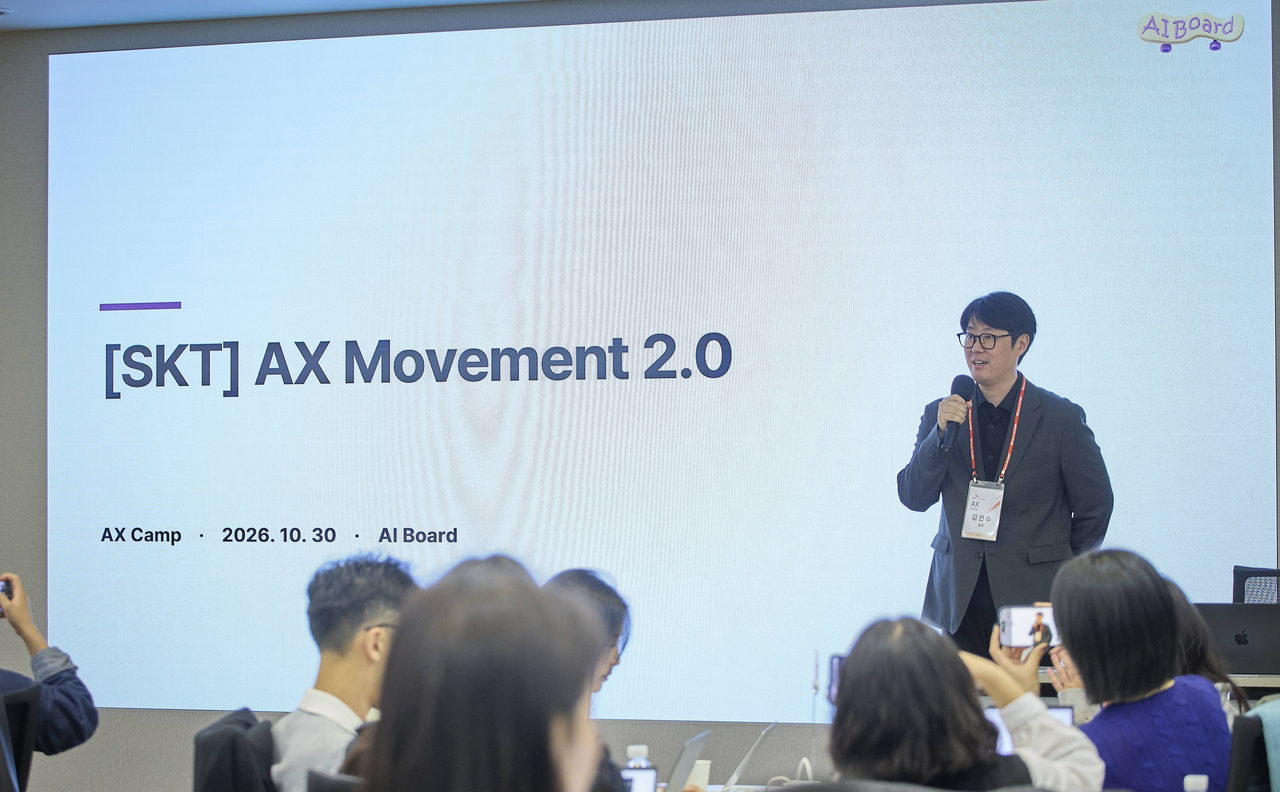
"We've solved most of the problems that individuals could handle on their own," Kim In-soo, head of SK Telecom's AI Board, told reporters Friday. "Now the more difficult problems, which require support from the company, are coming to the surface."
SK Telecom, which operates one of Korea's largest mobile networks, is developing its own AI models and investing in computing infrastructure to serve corporate customers. Earlier this month, CEO Jung Jae-hun outlined plans to use productivity gains from AI to redeploy employees to growth businesses.
The company's internal efforts also offer a practical example of the challenges businesses face when trying to make AI useful beyond individual tasks.
One involves the vast amounts of technical data accumulated through SK Telecom's mobile network operations. Much of it was designed for conventional software systems, making it difficult for AI agents to understand what individual data fields represent.
In a project involving roughly 9,000 databases and 300,000 data fields, the company used AI to generate explanations for technical labels. SK Telecom said the accuracy of AI-generated answers to related questions improved from around 40 percent to more than 80 percent.
Kim estimated that processing the data through external AI models could cost 100 million won to 200 million won ($75,000-$150,000) annually. SK Telecom instead used its own AI models and computing infrastructure, though it did not disclose the actual savings.
Data protection poses another challenge.
"You identify a task where AI could be highly effective, only to discover that the data it needs cannot be provided," Kim said, describing restrictions on sharing personal and confidential information with AI models.
SK Telecom has developed a system that keeps sensitive records separate from AI models, allowing agents to process tasks such as employee medical expense claims without directly accessing original data.
The company is also evaluating which agents justify their operating costs rather than simply encouraging employees to build more. "Our goal isn't simply to reduce the number of agents. It's to produce results," Kim said.
Despite the widespread adoption, SK Telecom has not disclosed how much its workplace AI initiatives have reduced costs or improved companywide productivity.
Asked about their financial impact, Kim said employees were completing individual tasks faster but declined to provide specific figures.
mjh@heraldcorp.com